Summary:
- Punggol Waterway Park offers an easy, scenic 4.2km walk where manmade features, urban convenience, and natural elements blend seamlessly, with abundant wildlife, bridges, viewpoints, and sunrise/sunset spots.
- Accessibility and amenities are top-notch, with direct MRT/LRT access, numerous entry points, clean restrooms, water coolers, plentiful shelters, and nearby malls, eateries, and carparks along almost the entire route.
- While not a wilderness escape, the park delivers a satisfying, comfortable outdoor experience enhanced by thoughtful design, hidden gems like a preserved old road, and a therapeutic garden.
All the way up in the far northeast of Singapore sits Punggol Waterway Park – and if you’ve ever wandered through it, you’ll know just how stunning this 25-hectare stretch can be.
The park (part of the North Eastern Riverine Loop) hugs both banks of the Punggol Waterway, Singapore’s longest manmade waterway, which connects Punggol Reservoir on one end to Serangoon Reservoir on the other.
It’s a surprisingly scenic 4.2km (estimated; one way) walk, where you get this almost effortless blend of convenience and nature.
One moment you’re passing a mall with all the creature comforts you could possibly need; the next, you’re crossing a bridge that gives you a postcard-perfect view of the waterway below.
Meanwhile, the reservoirs and the waterway itself are quietly alive with aquatic life.
Advertisement

Don’t forget to look up. You might catch a flash of colour from a Black-naped Oriole or a Long-tailed Parakeet. They’re often perched among the more than 4,800 trees planted along the waterway, or even on fruit trees like rambutan, chiku, and jackfruit that dot the area.
Despite being tucked away in the northeast, the park is highly accessible, sitting right next to Punggol MRT and the ever-busy Waterway Point mall.

It’s no surprise, then, that Punggol Waterway Park is one of North-eastern Singapore’s go-to green spaces.
Before dawn, early birds are already out getting their steps in before grabbing breakfast at any number of food spots nearby. Come evening, the joggers roll in, soaking up the cooler air and chasing those gorgeous sunset views.
How to get to Punggol Waterway Park
The simplest way to kick off your hike is from Punggol MRT. Once you alight, just walk through Waterway Point (via Exit A) – yes, literally straight through the mall – and you’ll pop out right at the park.
This route places you near the west end of the waterway (facing Punggol Reservoir) and is probably the most foolproof option for first-timers.
If you prefer starting elsewhere, you’ve got choices. Sam Kee and Oasis LRT stations are the standout alternatives.
Sam Kee LRT station drops you right around the midpoint, next to SAFRA Punggol, while Oasis LRT station lands you closer to the east end (facing Serangoon Reservoir) and the lively Oasis Terraces, which is actually a pretty solid neighbourhood mall if you want to grab a bite or stock up on drinks.

Because Punggol LRT is perched right above the MRT station, hopping over to any of these LRT stations is a breeze. Just a couple of stops and you’re there.
Drivers aren’t left out either. Beyond the obvious parking picks like Waterway Point, SAFRA Punggol, and Oasis Terraces, there’s also no shortage of HDB carparks lining almost the entire length of the waterway, making it convenient and affordable at the same time.
Also read:
To Be Or Not To Be On A Cycling Path? That Is The Confusing Singapore Question
Attempts by the authorities to separate riders from walkers are terrific, but the shared cycling and pedestrian paths remain as grey areas and no one wants to go to prison, muses Neil Humphreys.
Everdance: These 60 Seniors Have Danced In The Park Every Day For 10 Years
“I didn’t know it would last 10 years. But now, I want it to last for another 10 years,” says Everdance founder and dancing “auntie”, Koh Ya Fen.
What to expect at Punggol Waterway Park
Punggol Waterway Park isn’t your typical “escape into nature” kind of walk – and honestly, that’s part of its charm.

The beauty here comes from how the manmade elements and the natural sights play off each other.
Think themed bridges, wooden lookout towers, and the waterway itself snaking through the landscape, all set against open water views, curious aquatic and avian life, and those wide, unobstructed sunrise and sunset moments that people love to photograph.
The park is also woven right into the surrounding neighbourhood. Residential blocks, community spaces, and malls line the waterway, which means entry points are everywhere. You’re never far from a toilet, a cold drink, or a quick escape route if the weather turns. It’s nature with the comfort of knowing air-conditioning is only a few minutes away.
But if you’re after a true wilderness escape, this isn’t quite it. There’s plenty of greenery, but you’ll almost always have some sort of concrete block in your peripheral vision. A block of HDB flats here, a mall there, and soon, the massive Punggol Regional Sports Centre, slated to open in 2026.

Even so, the walk is genuinely satisfying. And to help you figure out whether it’s worth lacing up your shoes, we’ve put the park through our SilverStreak Walking Guide Scorecard, rating everything from accessibility to amenities to how scenic it really is. Scroll on to see how it stacks up.
Trail: Punggol Waterway Park
Difficulty Level: Easy
- Ease of Walk (18/20 points)
It honestly doesn’t get much easier than this. The entire park is lined with wide, well-paved paths, and some stretches even come with cobbled walkways if you’re feeling like a change in texture – or if you just prefer a bit more “terrain” underfoot.
The paths are also generous enough for both cyclists and pedestrians to coexist without the constant dance of dodging and yielding, which makes the whole experience a lot more relaxed.

If we had to nitpick, it’d be this: we just wish there were a few more bridges on some stretches. They’re the only way to hop from one bank to the other, so if you spot something interesting across the water, you might need to plan your route a little… or resign yourself to a bit of backtracking. Not a deal-breaker, but something to keep in mind.
- Accessibility (18/20 points)
MRT, LRT, buses – whichever mode of transport you pick, you’ll find yourself just a short stroll from the park. Add to that the many entry and exit points scattered along the waterway, plus a good mix of stairways and ramps, and it’s hard not to call Punggol Waterway Park the gold standard for accessibility.
This is especially so if you stay in the northeast of Singapore, or along the MRT’s North East Line.
Even the bridges get full marks. Every single one – yes, we checked – come equipped with handrails and ramps. So no matter your mobility needs, you won’t suddenly find yourself confronted with a staircase you can’t navigate.
And as mentioned before, carparks are abundant. Drivers have plenty of options whether you prefer parking your vehicle at a mall, at a HDB MSCP, or at an open-air carpark (there are two located along Sentul Crescent).
- Amenities (14/15 points)
Along the entire waterway, you’ll find no shortage of creature comforts. Benches are everywhere, public restrooms are surprisingly clean, and there are water coolers at rest stops for easy bottle refills.
In other words, amenities are abundant – and that’s before you even factor in the malls and eateries you’ll pass as you go.

Speaking of malls, Waterway Point is the heavyweight in the area, with the widest range of food and amenities (hello Don Don Donki). But don’t overlook the options at Oasis Terraces, where Anna’s Sourdough is a neighbourhood favourite, or at SAFRA Punggol, where Keng Eng Kee Seafood draws its fair share of fans.
If malls aren’t your vibe, there are also coffeeshops, mini-marts, and small independent spots tucked under the HDB blocks lining the waterway. Plenty of ways to refuel without wandering far.
- Scenery (11/15 points)
There’s definitely a bit of a trade-off here. All the modern comforts that make Punggol Waterway Park so convenient also mean you’ll rarely get a completely natural, untouched view. A building (or several) is almost always somewhere in your line of sight.
But don’t let that fool you into thinking the place lacks nature. There’s actually plenty of life around if you slow down and look. You might spot turtles paddling in the waterway, monitor lizards sunning themselves along the path, or birds perched in the many trees that line both banks.

And then there are the views. The sunrise and sunset scenes from Jewel Bridge on the west end and the aptly named Sunrise Bridge on the east end draw devotees every single day.
Whether you’re pausing mid-hike to soak it all in, or ending your walk with a quiet moment, these spots make the journey feel especially rewarding.
- Weather Protection (7/10 points)
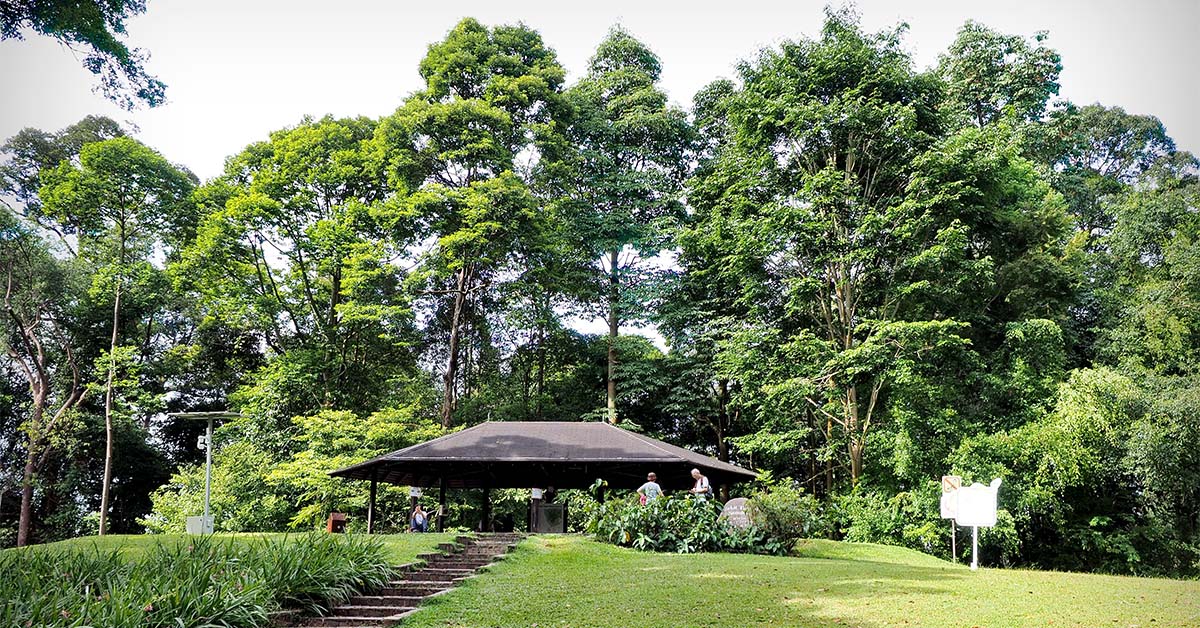
Even without ducking into nearby malls or HDB void decks, you’re never too far from shelter along the waterway. There are plenty of covered rest stops, each with its own charm: from wooden watchtowers and vine-draped gazebos to stone benches tucked under bridges and cute concrete nooks.

The one thing to watch out for? The sun. Some stretches have almost zero shade, so lather on that sunscreen and put on a hat before hitting the gravel paths. A little prep goes a long way in keeping your walk comfortable.
- Navigation (9/10 points)
Being so close to civilisation, finding your way around Punggol Waterway Park is almost foolproof. Sure, there are plenty of signs along the route if you need them, but honestly, you’ll hardly do.
The linear layout of the waterway makes it even easier. There are no confusing trails to get lost on. The only real “decision” comes when you want to hop from the north bank to the south bank, and even that is straightforward if you plan a little ahead.
- Bonus Points (6/10 points)
Just when you think the park has shown you everything, there are a few hidden gems for those who wander a little deeper (which grants the park some bonus points here).

Around the waterway’s midpoint – near Kelong Bridge and the Look-Out Pavilion – you’ll stumble upon a 160m stretch of the old Punggol Road. It’s easy to miss, but the preserved road comes complete with its original bus stop, now doubling as a quaint, sheltered rest spot.

Another under-the-radar highlight is the 900sqm therapeutic garden near the Adventure Bridge. Slightly elevated, it offers a quiet, peaceful view of the waterway from above, with secluded sitting spots on its slope that make it feel like a tiny nature escape tucked into the park.
- Verdict (83/100 points)
Punggol Waterway Park might feel a little too polished for those chasing a wild, untouched nature vibe, but it’s hard not to appreciate what it does well. The park nails the balance between modern urban comforts and the natural beauty of the waterway.
Bridges highlight the vistas, while food, drinks, toilets, and plenty of spots to rest make the whole walk a breeze while you get your steps in. It’s hard to find much to complain about – unless you’re after a true green escape, in which case a place like Kent Ridge Park might hit the spot better.
Even so, Punggol Waterway Park is a shining example of how thoughtful design and manmade structures can actually enhance, rather than detract from, nature’s charm.
| SilverStreak Walking Guide Scorecard Punggol Waterway Park Difficulty level: Easy |
|
|---|---|
| Ease of Walk | 18/20 |
| Accessibility | 18/20 |
| Amenities | 14/15 |
| Scenery | 11/15 |
| Weather Protection | 7/10 |
| Navigation | 9/10 |
| Bonus Points | 6/10 |
| Total Score | 83/100 |
About SilverStreak’s Walking Guide Scorecard
The scorecard rates parks across key categories that matter to visitors, from comfort and safety to the little touches that make a place memorable. Each category is scored to reflect the overall experience.
Ease of Walk: Measures how comfortable and manageable the paths are for strolling, including gradients and surface conditions.
Accessibility: Looks at how accessible the park is to visit via different transport options. Also considers features like railings, ramps, lighting, and barrier-free access for all visitors.
Amenities: Availability of conveniences such as toilets, benches, and food and drink options nearby.
Scenery: Evaluates the park’s atmosphere, greenery, and scenic views that contribute to relaxation.
Weather Protection: Looks at how well the park provides shade, rain shelters, or covered areas.
Navigation: Assesses clarity of maps, directional signs, and ease of finding one’s way around.
Bonus Points: Rewards unique or standout features that give the park added character and appeal.
Total Score: An aggregated score based on all the points above. A higher score indicates a better overall experience.
Difficulty Level: A separate indicator (Easy, Intermediate, or Hard) from the Total Score, used to gauge the overall challenge expected of the walk.
Keen to explore new hiking trails with fellow silvers? Check out our Jalan-Jalan Kakis today!